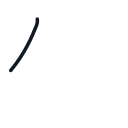
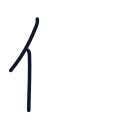
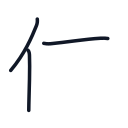
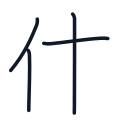
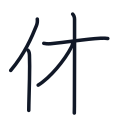
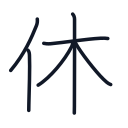
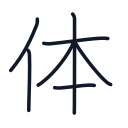
からだ
体
body
U+4F53
Unicode hex codepoint — a unique identifier for this character in the Unicode standard.
JLPT 4
Japanese-Language Proficiency Test level. N5 is beginner, N1 is the most advanced. This kanji appears at the 4 level.
Grade 2
Japanese school grade level in which this kanji is taught. Grade 1 is first year of elementary school.
7 strokes
Freq #88
Frequency rank among the ~2,500 most common kanji in Japanese newspapers. Lower number = more common.
Heisig #957
Index in James Heisig's "Remembering the Kanji" — a popular textbook that teaches kanji through mnemonics and stories.
Meanings
- body
- substance
- object
word
からだ karada Kun'yomi Kun'yomi (訓読み) — the native Japanese reading of this kanji. Used when the kanji appears alone or with okurigana (trailing hiragana).
たい tai On'yomi On'yomi (音読み) — the Sino-Japanese reading, derived from Chinese pronunciation. Most commonly used in compound words (jukugo).
全
体
zentai
whole
具
体
gutai
concrete
団
体
dantai
organization
体
験
taiken
experience
自
体
jitai
itself
身
体
shintai
body
体
制
taisei
system
一
体
ittai
what on earth
大
体
daitai
roughly
自
治
体
jichitai
local government
主
体
shutai
subject
本
体
hontai
main body
体
系
taikei
system
体
調
taichou
physical condition
体
重
taijuu
body weight
体
力
tairyoku
physical strength
肉
体
nikutai
physical body
体
質
taishitsu
constitution
媒
体
baitai
medium
解
体
kaitai
demolition
死
体
shitai
corpse
体
育
taiiku
physical education
実
体
jittai
substance
正
体
shoutai
true identity
地
方
自
治
体
chihoujichitai
local government
体
内
tainai
inside the body
字
体
jitai
font