Understanding On'yomi vs Kun'yomi: A Practical Guide
Not One Chinese -- Four
Most guides explain on'yomi as "the Chinese reading" and kun'yomi as "the Japanese reading." That framing is not wrong, but it obscures the real structure. On'yomi is not a single layer. It is four distinct historical strata, each borrowed from a different Chinese dialect at a different century, carrying different phonological fingerprints into modern Japanese.
The Four Layers of On'yomi
Chinese characters arrived in Japan in waves over roughly 1,200 years. Each wave carried the pronunciation of a different Chinese prestige dialect, and those pronunciations fossilized in Japanese as parallel reading systems.
| Layer | Japanese | Source | Era | Route | Domain |
|---|---|---|---|---|---|
| Go-on | 呉音 | Wu Chinese (Jiankang/Nanjing region) | 5th--6th c. | Via Korean peninsula | Buddhist liturgy, legal terms, early loans |
| Kan-on | 漢音 | Tang capital Chang'an (modern Xi'an) | 7th--9th c. | Direct embassy contact | Secular scholarship, the dominant modern layer |
| To-on | 唐音 | Song/Ming dynasty Chinese | 12th--17th c. | Zen monks, trade | Zen word, material culture, trade goods |
| Kan'yo-on | 慣用音 | N/A (conventionalized errors) | Various | Domestic drift | Readings that "should" follow Go/Kan rules but don't |

A section of the Heart Sutra (般若心経) hand-copied in Japan c. 755 AD, during the Nara period. Liturgical sutra-copying is exactly the channel that fixed Go-on pronunciations into Japanese: the same kanji 明 read as Kan-on メイ in secular text is still chanted as Go-on ミョウ in 光明 (kōmyō, "radiant light") because Buddhist recitation preserved the older Wu-Chinese stratum. Source: Wikimedia Commons.
Kan-on is the most common form today. The Nara court actively promoted Kan-on over Go-on for reading Chinese texts, but Go-on persisted in Buddhist ritual, where pronunciation was liturgically fixed. To-on is rare -- the lexicographer Otsuki Fumihiko's Genkai dictionary classified only 96 of its 13,546 Sino-Japanese entries as To-on, roughly 0.7% of the total.
One Character, Three Centuries
The kanji 明 (bright) preserves all three borrowing layers:
| Layer | Reading | Example compound | Era of borrowing |
|---|---|---|---|
| Go-on | ミョウ (myō) | 光明 (kōmyō, "radiant light" -- Buddhist term) | 5th--6th c. |
| Kan-on | メイ (mei) | 説明 (setsumei, "explanation"), 発明 (hatsumei, "invention") | 7th--9th c. |
| To-on | ミン (min) | 明朝体 (minchōtai, "Ming-dynasty typeface") | 12th--17th c. |
Other kanji with visible stratification: 行 has Go-on ギョウ/ゴウ (修行 shugyō, ascetic practice), Kan-on コウ (旅行 ryokō, travel), and To-on アン (行灯 andon, paper lantern). 京 has Go-on キョウ (東京 Tōkyō) and Kan-on ケイ (京浜 Keihin). 清 has Go-on ショウ (清浄 shōjō, purity -- Buddhist) and Kan-on セイ (清潔 seiketsu, cleanliness -- secular).
Kan'yo-on are the oddballs: 輸 "should" read シュ by regular Go/Kan rules, but the accepted on'yomi is ユ (輸出 yushutsu, export). 消 is read ショウ rather than the expected セイ. These are linguistic fossils of popular mispronunciation that hardened into standard usage.
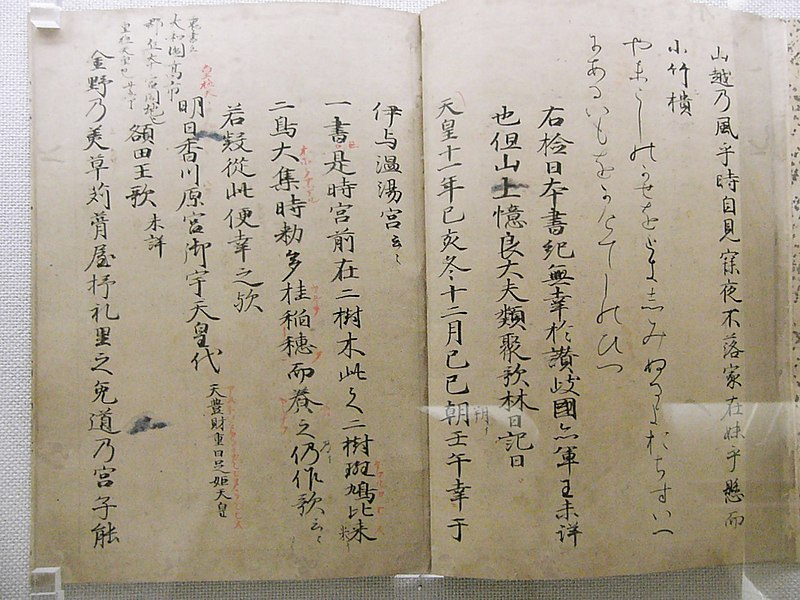
A page from the Genryaku-bon (元暦校本) manuscript of the *Man'yōshū, an 11th-century copy collated in 1184 of an 8th-century anthology. The Nara-period scribes who compiled the original had no native script — they wrote Japanese by deploying kanji for sound (man'yōgana, the seed of modern kana) and for meaning, sometimes in the same poem. This is the textual environment in which on'yomi and kun'yomi crystallized as parallel reading habits. Source: Wikimedia Commons.*
The Phonological Squeeze
Middle Chinese had a syllable structure that Japanese phonotactics could not accommodate: final stop consonants (-p, -t, -k), final nasals (-m, -n, -ŋ), and consonant clusters. Old Japanese permitted only open syllables (consonant + vowel) or syllable-final /n/. The borrowing process systematically resolved this mismatch:
| Middle Chinese final | Japanese adaptation | Example |
|---|---|---|
| -k | -ku, -ki | MC kwok → コク (国 koku) |
| -t | -tsu, -chi | MC nyit → ニチ (日 nichi, Go-on), ジツ (jitsu, Kan-on) |
| -p | -fu → weakened to -u | MC nyit-pwon → ニッポン / ニホン (日本) |
| -m, -n | -ン (moraic n) | MC kam → カン (感 kan) |
| -ŋ | Vowel lengthening (エイ, オウ, ウウ) | MC mjaeng → メイ (明 mei); MC kjaeng → ケイ (京 kei) |
The -ŋ → vowel lengthening rule is the subtlest and most consequential. It explains why so many on'yomi end in -ei or -ou: those long vowels are ghosts of a velar nasal that Japanese could not pronounce. High vowels also triggered palatalization: front vowel /i/ caused /t/ to surface as /ch/ (チ) rather than /tsu/ (ツ), which is why 日 has both nichi and jitsu depending on the borrowing layer.
The Joyo Kanji by the Numbers
The 2,136 joyo kanji carry a combined 2,352 on'yomi and 2,869 kun'yomi readings (Tamaoka et al., 2017). Kanji database analysis using 11 years of Mainichi Shimbun text (282 million tokens) reveals:
| Statistic | Value |
|---|---|
| Kanji with both on and kun readings | 1,240 (58.1%) |
| Kanji with multiple on'yomi | 272 (12.7%) |
| Kanji with multiple kun'yomi | 222 (10.4%) |
| Kango (Sino-Japanese) share of dictionary headwords | ~49% |
| Kango share of common speech | ~18--20% |
| Kango share of written/formal text | ~50--65% |
The gap between dictionary representation and spoken frequency is striking. Kango dominates formal registers -- law, science, administration -- while wago (native Japanese) dominates everyday speech. This register split is a direct consequence of the historical borrowing pattern: Chinese word entered Japan through elite channels (Buddhist scriptures, Confucian scholarship, imperial administration) and stayed concentrated in those domains.
Predicting Readings in Compounds
The "two-kanji compound → on'yomi" rule is the most useful heuristic in kanji reading, and it works well at beginner levels -- over 90% of common two-kanji compounds (熟語) use on-on readings. But the full picture includes four compound types:
- On-on (音音): 学校 gakkō, 電話 denwa -- the overwhelming majority
- Kun-kun (訓訓): 花火 hanabi, 名前 namae -- nature and everyday words
- Jubako-yomi (重箱読み, on-kun): 本屋 hon'ya, 台所 daidokoro
- Yuto-yomi (湯桶読み, kun-on): 場所 basho, 手帳 techō
Names are the hardest case. 田中 is kun-kun (Tanaka), not on-on. Place names and personal names routinely violate the on-on compound rule because they often preserve archaic native readings that predate the Chinese borrowing.
The practical takeaway: the on-on rule is reliable for content word. For names, look it up.
References
- Tamaoka, K., Makioka, S., Sanders, S., & Verdonschot, R.G. (2017). www.kanjidatabase.com: A new interactive online database for psychological and linguistic research on Japanese kanji. Behavior Research Methods, 49(5), 1731--1748.
- Otsuki, F. (1889--1891). Genkai (言海). Otsuki Fumihiko.
- Miyake, M.H. (2003). Old Japanese: A Phonetic Reconstruction. RoutledgeCurzon.
- Shibatani, M. (1990). The Languages of Japan. Cambridge University Press.
- Seeley, C. (1991). A History of Writing in Japan. University of Hawai'i Press.
- Frellesvig, B. (2010). A History of the Japanese Language. Cambridge University Press.