Kanji Atlas
Why does 早 mean early?
Component decomposition — kanji, graphemes, radicals connected by their parent links, the same way the full Atlas draws them.

Kanji Dictionary + Lessons for Nerds
Spaced-repetition lessons for 2,136 Jouyou Kanji and 10,000+ words. Start with first 80 Kanji that Japanese 1st grade students learn!
See it in action
Why does 早 mean early?
Component decomposition — kanji, graphemes, radicals connected by their parent links, the same way the full Atlas draws them.
Why does 今日 read きょう?
Per-kanji reading attribution — color-coded kunyomi, onyomi, nanori, jukujikun.
The whole compound has a meaning-based reading that doesn't decompose into per-kanji parts.
Pure on'yomi compound — both kanji use their Sino-Japanese readings.
Pure kun'yomi compound — second kanji is voiced (rendaku): かみ becomes がみ.
How we compare
The Kanji Atlas is a layered DAG of every kanji and its components — primitives at the bottom, composites at the top. No other dictionary draws it this way.
| My Kanji | Jisho | WaniKani | Anki | |
|---|---|---|---|---|
| Kanji Atlas (visual map) | Layered DAG Every kanji as a layered DAG — primitives at the bottom, composites at the top. Click any node to see ancestors and descendants light up. | — | — | — |
| Component breakdown | Per-kanji Per-kanji decomposition into radical, graphemes, and kanji-within-kanji. See exactly how every character is built. | Basic | Mnemonic system | — |
| Reading attribution | Color-coded In every compound, see which kanji contributes which sound — color-coded by reading type: kunyomi, onyomi, nanori, jukujikun. | — | — | — |
| SRS algorithm | FSRS-5 + SM-2 Hybrid FSRS-5 + SM-2 scheduler. FSRS-5 is the most accurate open SRS algorithm; we blend it with SM-2 so new cards stay stable. | — | Custom | SM-2 |
| Mastery visualization | Full grid Your knowledge of all 2,136 Jouyou kanji at a glance. Each cell glows red (new), yellow (learning), or green (solid recall). | — | Levels | — |
| Polyglot search | 4 inputs · 7 UIs Search by character (水), hex codepoint (6c34), English meaning (water), or romaji (mizu). UI in 7 languages: English, Japanese, Chinese, Korean, Indonesian, Vietnamese, Malay. | Multi-input | — | — |
| Free dictionary | Full Full dictionary access with no account, no login, no paywall — all 2,136 kanji, 10,476 words, components, readings, and stroke order. | Full | Locked | Community decks |
| Community | Growing | Large | Large | Massive |
| Price | Free / $4.92/mo | Free | $9/mo | Free |
The science
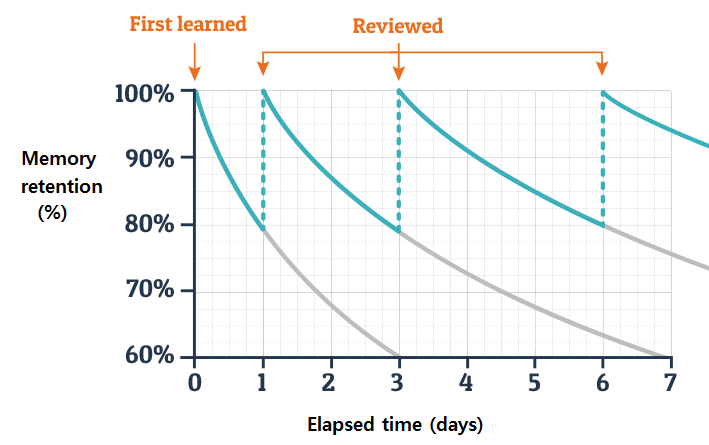
Reviewing material at gradually expanding intervals is the best method for long-term memory retention. The spacing effect is one of the most replicated findings in memory research, going back over a century.
Seminal Papers
Free dictionary. Pro study tools.
Full dictionary, no account required
$59/year, billed annually
See full pricing
Press ? anytime to toggle this dialog