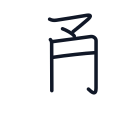
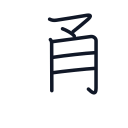
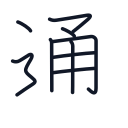
とお
通
pass through
U+901A
Unicode hex codepoint — a unique identifier for this character in the Unicode standard.
JLPT 4
Japanese-Language Proficiency Test level. N5 is beginner, N1 is the most advanced. This kanji appears at the 4 level.
Grade 2
Japanese school grade level in which this kanji is taught. Grade 1 is first year of elementary school.
10 strokes
Freq #80
Frequency rank among the ~2,500 most common kanji in Japanese newspapers. Lower number = more common.
Heisig #1408
Index in James Heisig's "Remembering the Kanji" — a popular textbook that teaches kanji through mnemonics and stories.
Meanings
- pass through
- commute
- traffic
- counter for letters
word
かよ kayo Kun'yomi Kun'yomi (訓読み) — the native Japanese reading of this kanji. Used when the kanji appears alone or with okurigana (trailing hiragana).
とお too Kun'yomi Kun'yomi (訓読み) — the native Japanese reading of this kanji. Used when the kanji appears alone or with okurigana (trailing hiragana).
つう tsuu On'yomi On'yomi (音読み) — the Sino-Japanese reading, derived from Chinese pronunciation. Most commonly used in compound words (jukugo).
普
通
futsuu
ordinary
通
信
tsuushin
communication
共
通
kyoutsuu
common
通
常
tsuujou
usually
交
通
koutsuu
traffic
を
通
じ
て
wotsuujite
through
通
じ
る
tsuujiru
to communicate
流
通
ryuutsuu
distribution
通
tsuu
connoisseur
通
貨
tsuuka
currency
通
知
tsuuchi
notification
通
勤
tsuukin
commuting to work
通
過
tsuuka
passage
通
訳
tsuuyaku
interpretation
通
販
tsuuhan
mail order
通
用
tsuuyou
common use
通
報
tsuuhou
report
通
産
省
tsuusanshou
Ministry of International Trade and Industry