Honorifics: Grammar That Encodes Hierarchy
What Is an Honorific?
An honorific is a grammatical or lexical device that encodes the speaker's social relationship to a referent — addressee, subject, bystander, or topic — directly into the form of the utterance. It is not vocabulary about politeness. It is politeness as morphosyntax: the social variable is fused into the verb stem, the pronoun paradigm, the noun, or the suffix system, such that you cannot construct a grammatical sentence without first taking a position on the social hierarchy.
Linguistic typology, following Comrie (1976) and the framework formalized by Brown & Levinson (1987), distinguishes four axes of honorific reference:
| Axis | Marks the relationship between speaker and... | Example languages |
|---|---|---|
| Addressee | the person being spoken to | T/V in French, German, Russian; Japanese です/ます |
| Referent (subject) | the person being talked about | Japanese 尊敬語 (sonkeigo), Korean -시- |
| Referent (object) | the person affected by the action | Japanese 謙譲語 (kenjōgo) |
| Bystander | a third party physically present | Dyirbal "mother-in-law language" (Jalnguy); Pohnpeian |
A language can mark any subset of these. English marks essentially none grammatically (we lean on lexical choice — "request" vs "ask"). French marks one (tu/vous). Japanese marks three. The Australian Dyirbal language famously marked all four, with an entire parallel "avoidance" lexicon used in the presence of taboo affines, documented in Dixon's 1972 grammar.
The World Atlas of Language Structures (WALS, Helmbrecht 2013) surveyed 207 languages on politeness distinctions in pronouns alone:
| System | # of languages | Share | Example |
|---|---|---|---|
| No politeness distinction | 136 | 65.7% | English, Mandarin, Finnish |
| Binary (familiar/polite) | 49 | 23.7% | French (tu/vous), Russian (ты/вы) |
| Multiple politeness levels | 15 | 7.2% | Hindi (तू/तुम/आप) |
| Pronouns avoided in polite contexts | 7 | 3.4% | Japanese, Korean, Burmese |
Japanese sits in the rarest typological cell. Pronouns are not graded — they are evaded. You don't conjugate "you"; you replace it with a name, a title, or nothing at all, and route the politeness load through the verb. This is the crucial structural fact most introductions miss.
Why Japanese Is the Limit Case
Japanese keigo (敬語, "respect language") is, by consensus among typologists, the most morphologically elaborated honorific system in any living language with a major literature. Shibatani (1990) calls it "the most fully developed honorific system among the world's major languages." Sohn (1999) argues Korean rivals it in grammatical scope but lacks Japanese's lexical depth. The closest competitor for sheer stratification is Javanese, which we'll come to.
Three properties make Japanese the limit case:
- Triadic structure. Three independent honorific registers — exalting, humbling, and polite — combine multiplicatively, not additively.
- Suppletive verbs. Common verbs have entirely different lexical roots in honorific registers. Not affixation, not derivation — suppletion.
- Mandatory marking. Unlike T/V languages where you can stay "neutral" in casual contexts, every Japanese sentence forces a register choice. There is no off switch.

The three standard business bows — eshaku (会釈, ~15°), keirei (敬礼, ~30°), and saikeirei (最敬礼, ~45°) — gradate respect by angle the same way keigo gradates it by morphology. Both systems are mandatory: there is no neutral, zero-angle posture in formal Japanese interaction. Source: Wikimedia Commons.
The Three Pillars
| Register | 漢字 | Honors | Mechanism | Example: "to eat" (taberu) |
|---|---|---|---|---|
| Sonkeigo (尊敬語) | 尊敬語 | the subject (raises them) | suppletion, prefix お/ご, passive form, お〜になる | 召し上がる (meshiagaru) |
| Kenjōgo (謙譲語) | 謙譲語 | the object (lowers speaker, indirectly elevating addressee/object) | suppletion, お〜する pattern | いただく (itadaku) |
| Teineigo (丁寧語) | 丁寧語 | the addressee (general politeness) | です/ます endings, prefix お | 食べます (tabemasu) |
The 2007 Bunkachō (Agency for Cultural Affairs) reform split kenjōgo into two — 謙譲語I (toward a specific honored person) and 謙譲語II (general humility, formerly called 丁重語) — and broke off 美化語 (bikago, "beautification language": お酒, お茶) from teineigo. The official scheme is now five-way. Most learners still operate with the classical three-way split because the practical contrasts haven't changed.
The combinatorics matter. A single utterance can stack: お読みになっていらっしゃいます (o-yomi ni natte irasshaimasu, "[the honored person] is reading") layers sonkeigo (お〜になる) + sonkeigo aspect (いらっしゃる as the honorific copula for いる) + teineigo (ます). Three independent honorific operations on one verb.
Suppletive Verbs: The Hardest Part
For about a dozen high-frequency verbs, keigo is not formed by affixation but by replacing the lexical root entirely. This is the single feature that gives Japanese learners the steepest cliff.
| Plain | Sonkeigo (raise subj.) | Kenjōgo (lower self) | Teineigo (polite) |
|---|---|---|---|
| する (do) | なさる | いたす | します |
| 行く (go) | いらっしゃる | 参る / 伺う | 行きます |
| 来る (come) | いらっしゃる / おいでになる | 参る | 来ます |
| いる (be/exist) | いらっしゃる | おる | います |
| 食べる (eat) | 召し上がる | いただく | 食べます |
| 飲む (drink) | 召し上がる | いただく | 飲みます |
| 見る (see) | ご覧になる | 拝見する | 見ます |
| 言う (say) | おっしゃる | 申す / 申し上げる | 言います |
| 聞く (hear/ask) | お聞きになる | 伺う / 承る | 聞きます |
| 知る (know) | ご存じだ | 存じる / 存じ上げる | 知っています |
| あげる (give) | くださる | 差し上げる | あげます |
| もらう (receive) | お受け取りになる | いただく / 賜る | もらいます |
Note that いらっしゃる collapses three plain verbs (行く / 来る / いる) into one honorific form. Context disambiguates. This is genuine suppletion — 召し上がる shares no morphological relationship with 食べる; you cannot derive one from the other. Linguistically, this is comparable to English go/went, where the past tense is a fossilized fragment of an entirely different Old English verb (wendan).
The verbs that suppletive — eating, drinking, going, coming, seeing, saying, doing, being — are precisely the most frequent verbs, which is the Zipfian pattern of irregularity that Lieberman et al. (2007) documented for English: regularization rate is inversely proportional to frequency to the 1/2 power. High-frequency verbs preserve archaic morphology. Keigo's suppletive class follows this universal — these are not random verbs, they are the cognitively most-rehearsed.
The Productive Patterns
For verbs without dedicated suppletive forms, two productive patterns generate honorifics:
| Pattern | Register | Formation | Example: 書く (write) |
|---|---|---|---|
| お〜になる | sonkeigo | お + verb-stem + になる | お書きになる |
| 〜(ら)れる | sonkeigo (lighter) | passive form repurposed | 書かれる |
| お〜する / お〜いたす | kenjōgo | お + verb-stem + する/いたす | お書きする |
| 〜ます | teineigo | stem + ます | 書きます |
The passive-as-honorific (〜れる/〜られる) is structurally fascinating: Japanese uses the same morphology for passive voice, potential mood ("can write"), spontaneous occurrence ("comes to mind"), AND honorific. Context disambiguates. Kuno (1973) argued these are not four homophones but reflections of a deep "agent-defocusing" function — when you make the agent grammatically backgrounded, you can read it as defocused (passive), uncontrolled (spontaneous), capable (potential), or socially exalted (too high to point at directly).
The honorific-as-passive trick is widespread cross-linguistically. Korean -시- is the canonical subject-honorific suffix, but it has clear historical links to passive/causative morphology. The pattern is so robust Brown & Levinson listed "point-of-view distancing" as one of their universal positive-politeness strategies.
Honorific Prefixes: お and ご
| Prefix | Origin | Used with | Examples |
|---|---|---|---|
| お | native Japanese (和語, wago) | mostly native nouns | お茶, お金, お母さん, お弁当 |
| ご | Sino-Japanese (漢語, kango) | mostly Sino-Japanese compounds | ご飯, ご家族, ご注文, ご連絡 |
The split is etymological: お for native vocabulary, ご for Chinese borrowings. Exceptions exist (お電話 is a native-prefix on a Sino-Japanese noun) and they are linguistic fossils worth noting — they tend to mark words that entered general usage so early they "naturalized."
Bunkachō reclassified bare お/ご uses (お酒, お茶) as 美化語 (bikago, "beautification language") rather than true keigo. The distinction: when お marks respect toward someone (お母さんのお茶 = "your mother's tea"), it's keigo; when it just marks formal register (女性はお茶を飲む, "women drink tea"), it's bikago. This re-analysis was driven by corpus evidence that bare お/ご is now used regardless of social context, particularly in advertising and women's speech.
The Suffix System: san, sama, kun, chan, sensei, senpai, dono
Japanese's referent honorific suffixes attach to names. Choosing the right one is a sociolinguistic decision per relationship.
| Suffix | 漢字 | Register | Used for | Notes |
|---|---|---|---|---|
| さん | — | neutral polite | most adults, default | Etymologically a contraction of 様 (sama) |
| 様/さま | 様 | high formal | customers, deities, letters | 神様 (kami-sama, "the god") |
| 君/くん | 君 | familiar (typically male juniors) | younger men, schoolboys, subordinates | Used for women in some workplaces — controversial |
| ちゃん | — | affectionate | children, close female friends, pets | Phonetic softening of さん |
| 先生 | 先生 | professional respect | teachers, doctors, lawyers, novelists, politicians | Replaces other suffixes; standalone term of address |
| 先輩 | 先輩 | seniority | senior at school/work | Hierarchical, not neutral; pairs with 後輩 (kōhai) |
| 殿/どの | 殿 | archaic-formal | written documents, official letters | Survived in legal/administrative usage |
| 氏 | 氏 | journalistic-formal | newspapers, public figures | Distancing, used in third-person writing |
| 閣下 | 閣下 | "Your Excellency" | ambassadors, generals | Diplomatic only |
| 陛下 | 陛下 | "His/Her Majesty" | the Emperor/Empress only | One referent in modern Japanese |
The suffix is not optional. Naked names — yobisute (呼び捨て) — are reserved for intimates, subordinates, or contempt. Calling your boss "Tanaka" instead of "Tanaka-san" would register as a serious breach in any but the most informal start-up. The empty slot is itself a marker.
Suzuki Takao (鈴木孝夫) in his classic Words in Context (1973/1978) showed that Japanese second-person reference operates on a positional logic: you don't address someone by their identity, you address them by their role-relation to you. A child calls his older brother onii-san (literally "older brother"), but the older brother calls the younger by name. The same person is otōsan to one speaker and jichan (uncle) to another, simultaneously. This is why pronouns are evaded — there is no fixed perspective from which a single pronoun would be valid.
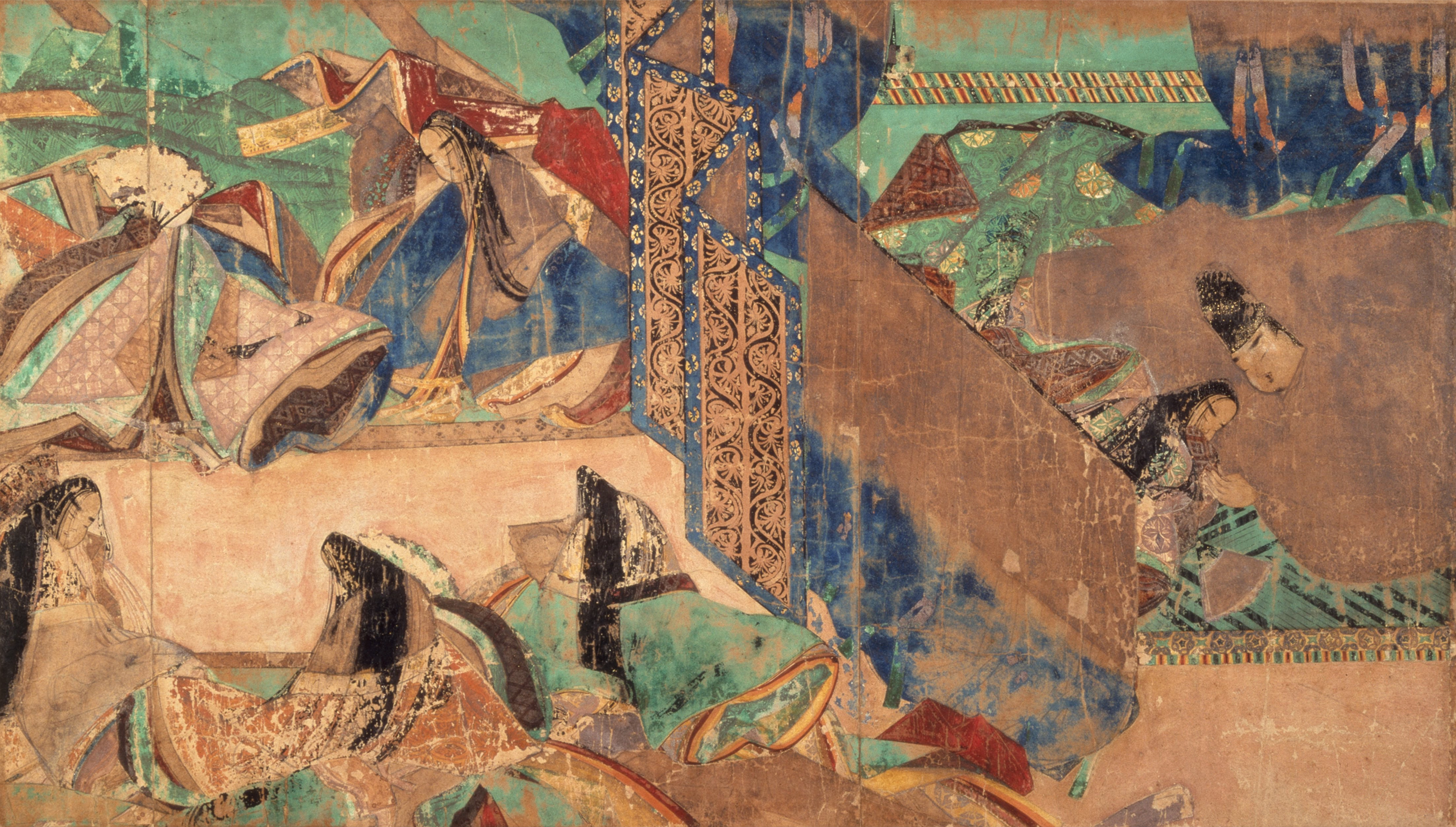
Scene from the Genji Monogatari Emaki ("Yadorigi" chapter), c. 1130, Tokugawa Art Museum. The hierarchical court society depicted here — segmented by curtains, screens, and seating position rather than direct address — is the social world in which the keigo system crystallized. Murasaki Shikibu's prose in this period already deploys a fully suppletive honorific verb system. Source: Wikimedia Commons.
Numbers: How Much Keigo Is in the Wild
Heinrich (2012) and the Bunkachō annual surveys on Japanese language attitudes give us actual usage data:
| Statistic | Value | Source |
|---|---|---|
| Adults who report difficulty using keigo correctly | 64% | Bunkachō Kokugo Yoron Chōsa, 2018 |
| Workers who received explicit keigo training in onboarding | 81% | NHK Workplace Language Survey, 2019 |
| Verbs in core suppletive keigo paradigm | ~13 | Tsujimura (2013) |
| Keigo-related entries in Kōjien (広辞苑) | 1,200+ | Iwanami Shoten, 7th ed. |
| Words that take お/ご prefix in modern usage | ~1,800 | NINJAL BCCWJ corpus |
The 64% self-reported difficulty figure is striking. It is not a learner's problem — it's a native speaker's anxiety. Keigo is taught explicitly in junior high school (中学), reviewed in high school, and most large companies run mandatory manner kenshū (マナー研修) for new hires that includes 30+ hours on keigo and bijinesu manā. Books like Iitai Koto ga Kichinto Tsutawaru "Keigo" no Hon sell tens of thousands of copies per year; the genre is its own publishing vertical.
The folk anxiety reflects a real complexity. Niyekawa's 1991 Minimum Essential Politeness — written for diplomats — runs 300+ pages and concludes there is no shortcut to fluency.
Cross-Linguistic Comparison: The Honorific Belt
Honorific systems comparable to Japanese cluster geographically across East and Southeast Asia:
| Language | Family | Mechanism | Distinct lexical strata |
|---|---|---|---|
| Japanese | Japonic | suffix + suppletion + prefix | 3–5 |
| Korean | Koreanic | -시- subject suffix + 6 sentence-final levels | 6 (해라/해/하게/하오/해요/합니다) |
| Javanese | Austronesian | parallel lexicons (ngoko/madya/krama) | 3 |
| Balinese | Austronesian | 4 strata + caste-restricted lexicons | 4 |
| Tibetan (Lhasa) | Sino-Tibetan | suppletive verbs + nominal honorifics | 3 |
| Thai | Tai-Kadai | royal vocabulary (rachasap) + pronoun cascade | 5+ |
| Vietnamese | Austroasiatic | kinship-based pronoun system | gradient |
Errington's Shifting Languages (1998) on Javanese is the canonical study: the krama (high) lexicon and ngoko (low) lexicon are largely non-overlapping — over 800 distinct word pairs. A high-status interlocutor demands a near-complete lexical substitution, not just a register shift. Javanese is, by some measures, more honorific-elaborated than Japanese — but it has been losing speakers and ground to Indonesian since 1945, while Japanese keigo remains stable in adult usage.
Korean is closest to Japanese in grammatical mechanism. The subject-honorific suffix -시- (-si-) attaches to the verb stem just like a Japanese sonkeigo passive: 가다 (kada, "go") → 가시다 (kasida, "[honored person] goes"). Then the addressee-honorific level (haerache 해체, haeyo 해요체, hapsyo 합쇼체, etc.) is layered on top of that. Two grammatical dimensions, multiplicative — exactly the Japanese sonkeigo × teineigo split. Sohn (1999) is the definitive treatment.
Notably, English is an outlier even among Indo-European languages — it lost the T/V distinction in the 17th century when thou fell out of use, leaving you as the universal pronoun. Brown & Gilman's classic 1960 paper "The Pronouns of Power and Solidarity" traced the European T/V system and is required reading for anyone interested in honorifics — it formalized the power and solidarity axes that have driven sociolinguistic theory ever since.
Sociolinguistic Drift: Is Keigo Eroding?
The data say: not really, but the function is shifting.
Heinrich (2012) and Wetzel (2004) document a 50-year shift from vertical keigo (status-based, asymmetric) to horizontal keigo (distance-based, symmetric). In pre-war Japan, keigo encoded a fixed status hierarchy: a wife used keigo to her husband; an employee used keigo to a boss who responded in plain form. By 2000, that asymmetry collapsed in domestic and many workplace contexts. Today's keigo is more often bilateral — both parties use polite forms because they don't know each other well, not because one outranks the other.
A telling marker: the Bunkachō surveys show "I use keigo with my own family" dropped from 38% (1995) to 9% (2018). But "I use keigo with strangers regardless of age" rose from 51% to 78%. Function shifted from rank to relational distance.
The much-discussed baito-keigo (バイト敬語, "part-timer keigo") — phrases like yoroshikatta deshō ka ("would that have been alright?", with redundant past-tense politeness) heard in convenience stores — is technically ungrammatical by classical keigo rules but represents a productive innovation: workers under-trained in formal keigo invent new hyper-polite forms by stacking redundant markers. Inoue (2006) treated this as evidence that keigo is alive and re-grammaticalizing, not dying.
The Cognitive Argument
Niyekawa (1991) and others have argued that keigo enforces perspective-taking: you cannot frame an utterance without first positioning yourself, your addressee, and any third-party referent on a hierarchy. This is a non-trivial cognitive load — but it's also a forced empathy training.
Recent psycholinguistic work has tested this. Hasegawa et al. (2014) used fMRI to compare brain activity when Japanese subjects processed plain vs. keigo sentences. Keigo activated the right temporo-parietal junction (rTPJ) — the area most consistently associated with theory of mind and perspective-taking (Saxe & Kanwisher, 2003). Plain forms didn't. Reading the appropriate keigo register isn't just lexical retrieval; it is a social-cognitive task with measurable neural correlates.
Whether that means keigo speakers exhibit measurably different perspective-taking outside language is unsettled. The Sapir-Whorf-shaped version of this claim is hard to test. But the fMRI signal is real, and it suggests keigo is not just decoration on top of propositional content — it is a parallel social-modeling computation, running on different cortex.
Recommended Reading
The canonical works, in roughly increasing technicality:
- Niyekawa, A.M. (1991). Minimum Essential Politeness: A Guide to the Japanese Honorific Language. Kodansha International. — Practical, written for diplomats. The most-referenced learner book.
- Wetzel, P.J. (2004). Keigo in Modern Japan: Polite Language from Meiji to the Present. University of Hawai'i Press. — Sociohistorical, traces the 1900–2000 shift.
- Suzuki, T. (1978). Words in Context: A Japanese Perspective on Language and Culture. Kodansha. — On pronoun avoidance and role-based reference. A classic.
- Shibatani, M. (1990). The Languages of Japan. Cambridge UP. — Chapter 12 is the typological treatment.
- Brown, P. & Levinson, S. (1987). Politeness: Some Universals in Language Usage. Cambridge UP. — The universal framework. Required reading.
- Sohn, H.-M. (1999). The Korean Language. Cambridge UP. — For the closest typological comparison.
- Errington, J.J. (1998). Shifting Languages: Interaction and Identity in Javanese Indonesia. Cambridge UP. — For the Javanese stratification system.
- Bunkachō (2007). Keigo no Shishin (敬語の指針). — The official 5-part reform. Free PDF.
- Brown, R. & Gilman, A. (1960). The Pronouns of Power and Solidarity. — The foundational T/V paper.
- Helmbrecht, J. (2013). Politeness Distinctions in Pronouns. WALS Online, ch. 45. — Cross-linguistic typology, free.
The Map
| # | Feature | Key insight |
|---|---|---|
| 1 | Honorific axis | Speaker can encode relation to addressee, subject, object, or bystander |
| 2 | Japanese rarity | Pronouns are evaded, not graded — top 3.4% of WALS sample |
| 3 | Three pillars | Sonkeigo + Kenjōgo + Teineigo combine multiplicatively |
| 4 | Suppletion | Top-frequency verbs use entirely different lexical roots |
| 5 | Productive forms | お〜になる / お〜する / 〜ます scale to all verbs |
| 6 | お vs ご | Etymological split: native vs Sino-Japanese |
| 7 | Suffix system | san/sama/kun/chan/sensei/senpai mark referent on each name |
| 8 | Pronoun avoidance | Role-relations replace fixed-perspective pronouns |
| 9 | Cross-linguistic | Korean -시- mirrors structure; Javanese rivals depth |
| 10 | Drift | Vertical (status) → horizontal (distance) over 1945–2020 |
| 11 | Cognitive load | rTPJ activation suggests parallel social-modeling computation |
Every grammatical sentence in Japanese is a hierarchy claim. There is no neutral form. That is the linguistic fact most worth understanding before any vocabulary list.