From Oracle Bones to Three Scripts: How Chinese Characters Diverged Across East Asia
3,200 Years of Continuous Deployment
The kanji you study today descend from inscriptions carved into turtle shells during the late Shang dynasty. That lineage -- from Anyang divination pits to the postwar reform committees of Tokyo and Beijing -- is one of the longest unbroken histories of any information technology still in daily production use.

A tortoise plastron with divination inscription from the reign of King Wu Ding (c. 1200 BCE), housed at the National Museum of China. The cracks were produced by applying heat to the reverse; the diviner's verdict ("auspicious") is recorded at the bottom right. Source: Wikimedia Commons.
The Script Stack: Six Eras
Chinese writing did not evolve gradually. It underwent discrete phase transitions, each driven by changes in writing medium, political unification, or bureaucratic speed requirements.
| Era | Script | Chinese | Approximate Dates | Medium / Driver |
|---|---|---|---|---|
| 1 | Oracle Bone | 甲骨文 | c. 1250--1050 BCE | Ox scapulae, turtle plastrons; divination |
| 2 | Bronze | 金文 | c. 1100--256 BCE | Cast bronze vessels; ritual, legal records |
| 3 | Seal | 篆書 | c. 770 BCE--220 CE | Li Si's standardization under Qin Shi Huang (221 BCE) |
| 4 | Clerical | 隸書 | c. 220 BCE--220 CE | Bamboo strips, brush and ink; bureaucratic speed |
| 5 | Regular | 楷書 | c. 200 CE--present | Paper; the form transmitted to Japan, Korea, Vietnam |
| 6 | Simplified | 简体字 | 1956--present | PRC reform; also Japan's shinjitai (1946) |
The transition from seal to clerical script was the decisive break. Seal script preserved the curvilinear, pictographic quality of bronze inscriptions. Clerical script (隸書 lishu), developed by Qin-era clerks who needed to write faster on bamboo strips, flattened curves into angular strokes and introduced the horizontal-sweeping 波磔 (bozhe) brush technique. This "clerical change" (隸變 libian) is why modern characters look nothing like their pictographic ancestors -- the abstraction happened over 2,000 years ago. The Wikimedia Commons Ancient Chinese Characters Project maintains SVG files showing characters like 馬 (horse), 水 (water), and 日 (sun) across all script stages.
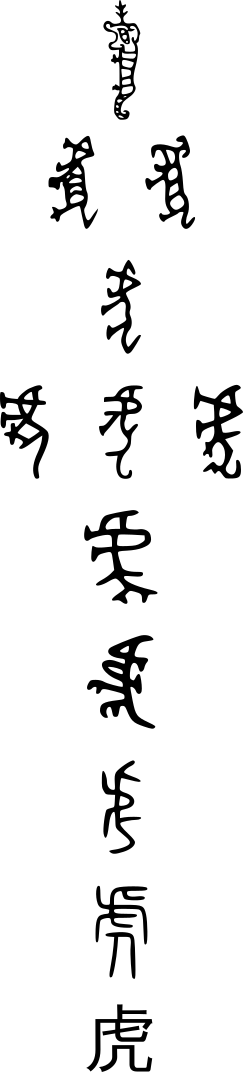
The character 虎 (tiger) traced across nine stages: early and late Shang oracle bone, four Western Zhou bronze inscriptions, Spring & Autumn bronze, Qin small seal, and the modern form. The pictographic crouched cat is unmistakable in the oracle bone glyph and entirely abstracted by the seal stage -- a vivid illustration of the libian "clerical change." Source: Wikimedia Commons.
Crossing to Japan: Sword, Sutra, and Scholar
Chinese characters reached Japan through the Korean peninsula. The traditional account credits Wani (王仁), a scholar from the Baekje kingdom who, according to the Kojiki (712 CE), arrived around 404 CE carrying ten volumes of the Analects and one volume of the Thousand Character Classic. Wani's historicity is debated -- he appears only in Japanese sources -- but the material evidence is concrete. The Inariyama Sword, excavated from a 5th-century burial mound in Saitama Prefecture, bears 115 gold-inlaid Chinese characters dated to 471 CE: the earliest confirmed use of Chinese writing in Japan.
By the 6th century, Buddhist sutras and diplomatic documents in Literary Chinese circulated widely among the court. But Japanese is polysyllabic and agglutinative -- structurally opposite to monosyllabic, isolating Chinese. This mismatch forced the most consequential script adaptation in East Asian history.
Man'yogana: One Script Becomes Three
By the Nara period (710--794), scribes used certain kanji purely for their sound values, ignoring meaning. This system -- man'yogana (万葉仮名) -- employed up to 970 kanji to represent roughly 90 Japanese morae. In the 9th century, two simplifications diverged: hiragana from cursive (草書) whole-character forms used in court correspondence, and katakana from fragments extracted by Buddhist monks annotating sutras. Some derivation examples -- 67% of modern kana pairs trace to the same source kanji:
| Mora | Hiragana | Source | Katakana | Source |
|---|---|---|---|---|
| a | あ | 安 | ア | 阿 |
| i | い | 以 | イ | 伊 |
| u | う | 宇 | ウ | 宇 |
| ka | か | 加 | カ | 加 |
| shi | し | 之 | シ | 之 |
| te | て | 天 | テ | 天 |
| ru | る | 留 | ル | 流 |
The full derivation chart maps all 46 modern morae to their man'yogana sources.
Three Paths of Simplification
After World War II, three governments independently reformed the same inherited script.
Japan's shinjitai (新字体, 1946). The Toyo Kanji list simplified 332 of 1,850 official characters. The most extreme case: 廳 (25 strokes) became 庁 (5 strokes), removing 20 strokes. But reform was conservative -- only ~15% of the set was modified, often adopting pre-existing historical variants. The Joyo list expanded to 2,136 characters by 2010.
China's jiantizi (简体字, 1956/1964). The PRC's two-phase scheme simplified 2,236 characters -- roughly 64% of the 3,500 most common forms. Methods were more radical: component substitution, cursive adoption, and phonetic replacement.
Traditional Chinese (繁體字) survived in Taiwan, Hong Kong, and Macau. Only ~30% of simplified Chinese forms match their shinjitai equivalents.
| Meaning | Traditional | Trad. Strokes | Japanese | JP Strokes | Simplified | Simp. Strokes |
|---|---|---|---|---|---|---|
| country | 國 | 11 | 国 | 8 | 国 | 8 |
| study | 學 | 16 | 学 | 8 | 学 | 8 |
| dragon | 龍 | 16 | 竜 | 10 | 龙 | 5 |
| drawing | 圖 | 14 | 図 | 7 | 图 | 8 |
| iron | 鐵 | 21 | 鉄 | 13 | 铁 | 10 |
| wide | 廣 | 15 | 広 | 5 | 广 | 3 |
| old | 舊 | 17 | 旧 | 5 | 旧 | 5 |
| doctor | 醫 | 18 | 医 | 7 | 医 | 7 |
Note 竜 vs. 龙: Japan revived a Warring States-period variant; China reduced strokes more aggressively. Both diverged from 龍, arriving at different destinations.
Kokuji: Characters Japan Invented
Japan coined entirely new characters called kokuji (国字) -- an estimated 400+ exist, with 9 in the Joyo list. Their component logic reveals how fluent users think about character construction:
| Kokuji | Reading | Meaning | Components | Logic |
|---|---|---|---|---|
| 峠 | toge | mountain pass | 山 + 上 + 下 | mountain where you go up then down |
| 働 | hataraku | to work | 亻+ 動 | a person who moves |
| 畑 | hatake | dry field | 火 + 田 | a field cleared by burning |
| 辻 | tsuji | crossroads | 辶 + 十 | a road meeting a cross |
| 鰯 | iwashi | sardine | 魚 + 弱 | a weak fish (spoils quickly) |
| 榊 | sakaki | sacred tree | 木 + 神 | tree of the gods |
| 腺 | sen | gland | 月(肉) + 泉 | flesh + spring (secretion) |
| 躾 | shitsuke | discipline | 身 + 美 | making the body beautiful |
Most kokuji carry only kun'yomi -- there was no Chinese pronunciation to borrow. A few made the return trip: 腺 (gland) and 働 (work) were adopted into Chinese, receiving Mandarin readings via the Guobiao standard.
The Wider CJK Picture
Japan was not alone. Korea used hanja for centuries before Sejong promulgated hangul in 1443, and coined a small number of gukja (國字) including 畓 (답, paddy field). South Korea retains hanja mainly for disambiguation; North Korea abolished them in 1949.
Vietnam developed chu Nom (字喃), expanding Chinese characters with thousands of Vietnamese-coined forms -- far exceeding Japan's ~400 kokuji. The Nom Preservation Foundation catalogs over 25,000 chu Nom characters. Vietnam abandoned Han characters for the Latin-based quoc ngu in the early 20th century -- the only major CJKV civilization to fully exit the logographic tradition.
Unicode's CJKV Unified Ideographs now encode over 97,000 characters across these traditions -- a digital reconciliation of divergences that began on oracle bones 32 centuries ago.
References
- Boltz, William G. "Early Chinese Writing." World Archaeology 17.3 (1986): 420--436.
- Seeley, Christopher. A History of Writing in Japan. University of Hawai'i Press, 2000.
- Hannas, William C. Asia's Orthographic Dilemma. University of Hawai'i Press, 1997.
- DeFrancis, John. The Chinese Language: Fact and Fantasy. University of Hawai'i Press, 1984.
- Oracle Bone Script. Wikipedia.
- Differences between Shinjitai and Simplified Characters. Wikipedia.
- Kokuji. Wikipedia.
- Comparison of Hiragana and Katakana Derivations. Wiktionary.
- Chu Nom. Wikipedia.
- Ancient Chinese Characters Project. Wikimedia Commons.