The Greatest Books Ever Written About Kanji
The Definitive Kanji Bookshelf, Benchmarked
The Western learner's kanji bookshelf is a graveyard of abandoned Heisig volumes. The Japanese scholar's shelf tells a different story -- decades-long reference projects that mapped an entire writing system. Here is every book that matters, benchmarked honestly.
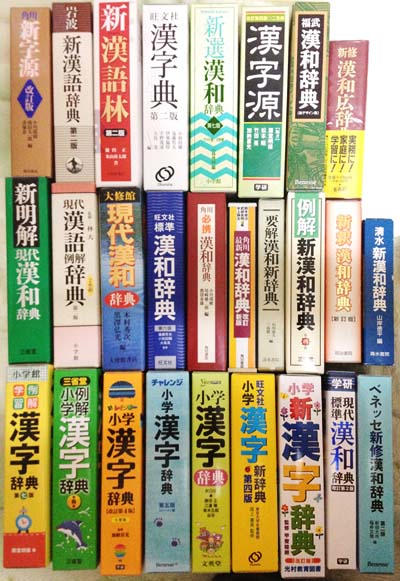
A row of 漢和辞典 (kanji-Japanese dictionaries) sold in Japan, past and present. Source: Wikimedia Commons.
The Comparison Table
| Book | Author | Year | Characters | Methodology | Verdict |
|---|---|---|---|---|---|
| Remembering the Kanji I | Heisig | 1977 (6th ed. 2011) | 2,200 | Primitive decomposition + narrative mnemonic | Revolutionary idea, controversial execution |
| Kodansha Kanji Learner's Course | Conning | 2013 | 2,300 | Graphical similarity + systematic readings | Most methodologically complete single volume |
| Guide to Remembering Japanese Characters | Henshall | 1988 (2nd ed. 1998) | 2,141 | Etymological analysis per character | Rigorous but dry; a reference, not a course |
| Complete Guide to Japanese Kanji | Seely & Henshall | 2016 | 2,136 | Updated etymologies, revised Joyo | Definitive English etymological reference |
| Kanji in Context | IUC | 1994 (rev. 2013) | 1,945 | word-centric, ~7,500 compounds | Brutal and effective; assumes kana fluency |
| The Kanji Dictionary | Spahn & Hadamitzky | 1996 | 6,355 | Custom 79-radical lookup | Engineered for speed over tradition |
| Dai Kanwa Jiten (大漢和辞典) | Morohashi Tetsuji | 1955--60 (rev. 1984--86) | 49,964 | Exhaustive historical/literary citation | Largest kanji dictionary ever. 13 volumes. Nothing else comes close. |
| Jito/Jikun/Jitsu trilogy | Shirakawa Shizuka | 1970--2004 | ~7,000+ | Paleographic analysis, ritual origins | Controversial, brilliant, untranslated |
The Methodology Spectrum
| Book | Meaning vs. Reading | Ordering | Approach | Solo vs. Classroom |
|---|---|---|---|---|
| Heisig RTK | Meaning-only (Vol. I) | Component | Mnemonic | Solo |
| Kodansha KLC | Integrated | Component + frequency | Hybrid | Solo |
| Henshall / Seely | Integrated | Joyo number | Etymological | Reference |
| Kanji in Context | Reading-heavy | Frequency | Contextual | Classroom |
| Spahn & Hadamitzky | Integrated | Radical (custom 79) | Lookup | Reference |
| Shirakawa trilogy | Meaning-deep | Historical | Paleographic | Academic |
The Books, Examined
Heisig's RTK splits kanji learning into two phases: meaning first (Vol. I), readings later (Vol. II). He decomposes characters into "primitives" -- not radicals, not etymological components, but narrative anchors. The controversy is real: separating meaning from reading creates learners who recognize 語 as "language" but cannot produce go or kataru. Many learners complete Volume I (2,200 characters in 1--3 months) but never finish Volume II.
Conning's Kodansha KLC is what Heisig should have been. Each entry teaches meaning, all standard readings, and word compounds -- integrated from entry one. His sequencing groups graphically similar characters (学 before 覚) while weighting frequency so common characters appear early. 992 pages, dense but navigable. Main weakness: no stroke order diagrams.
Henshall and Seely do what no other English-language authors attempt: trace each character's actual historical evolution from oracle bone to modern form. Where Heisig invents a story for 休 ("person + tree = rest"), Henshall documents that it depicts a person leaning against a tree -- similar conclusion, grounded in Bronze Age evidence.
Shirakawa Shizuka is the most important name on this list that most learners will never encounter. His "Shirakawa grammatology" argued that many characters encode Shang dynasty ritual practices -- sacrificial vessels, shamanistic rites, oath ceremonies. The character 告 (tell), conventionally "cow + mouth," Shirakawa read as a sacrificial prayer stick before an altar. He received the Order of Culture in 2004. His trilogy -- Jito (字統), Jikun (字訓), Jitsu (字通) -- remains untranslated.
Spahn & Hadamitzky solved a practical problem: the Kangxi 214-radical system is terrible for lookup. Their 79-radical system collapses variants (氵 and 水 are one radical) and prioritizes visual position. Result: any character in under 30 seconds. 6,355 characters, 47,000 compounds.
Morohashi's Dai Kanwa Jiten is not a learning tool. It is a monument. Compiled 1925--1960, spanning 13 volumes: 49,964 main entries, ~530,000 compound words with citations from Chinese and Japanese classical literature. The original plates were destroyed in a 1945 air raid and had to be reconstructed. No other single-language kanji dictionary approaches its scope. It is the final word.

Tetsuji Morohashi (諸橋轍次, 1883--1982), the lexicographer who spent 35 years compiling the Dai Kanwa Jiten. Source: Wikimedia Commons.
References
- Heisig, James W. Remembering the Kanji I. 6th ed. U. of Hawai'i Press, 2011. 518 pp.
- Conning, Andrew Scott. Kodansha Kanji Learner's Course. Kodansha, 2013. 992 pp.
- Henshall, Kenneth G. A Guide to Remembering Japanese Characters. Tuttle, 1988.
- Seely, Christopher & Henshall. Complete Guide to Japanese Kanji. Tuttle, 2016.
- Shirakawa Shizuka. Jito (字統, 1984), Jikun (字訓, 1987), Jitsu (字通, 1996). Heibonsha.
- Spahn, Mark & Hadamitzky. The Kanji Dictionary. Tuttle, 1996. 1,748 pp.
- Morohashi Tetsuji. Dai Kanwa Jiten (大漢和辞典). Taishukan, 1955--60. 13 vols.